Why Annual Sell-Out Growth Hides What Happens in the Quarter
 ·
Positive annual consolidation masks channel fluctuations. Discover how to separate volatility from stockouts and demand in pharmaceutical operations.
The annual consolidated data looks positive, but the quarterly result has slowed down, and the field team does not know if the drop came from demand, stockouts, or assortment. This sentence summarizes the daily tension faced by commercial and trade marketing leadership in the pharmaceutical channel. Looking at the twelve-month accumulated data provides executive comfort, but blinds the operation to the movement happening right now.
It is true that major market indicators reveal the macroeconomic health of the category and help justify strategic planning to the board. The mistake lies not in tracking these numbers, but in trying to use them to decide where the sales representative should take action tomorrow morning or which retail chain urgently needs intervention regarding assortment.
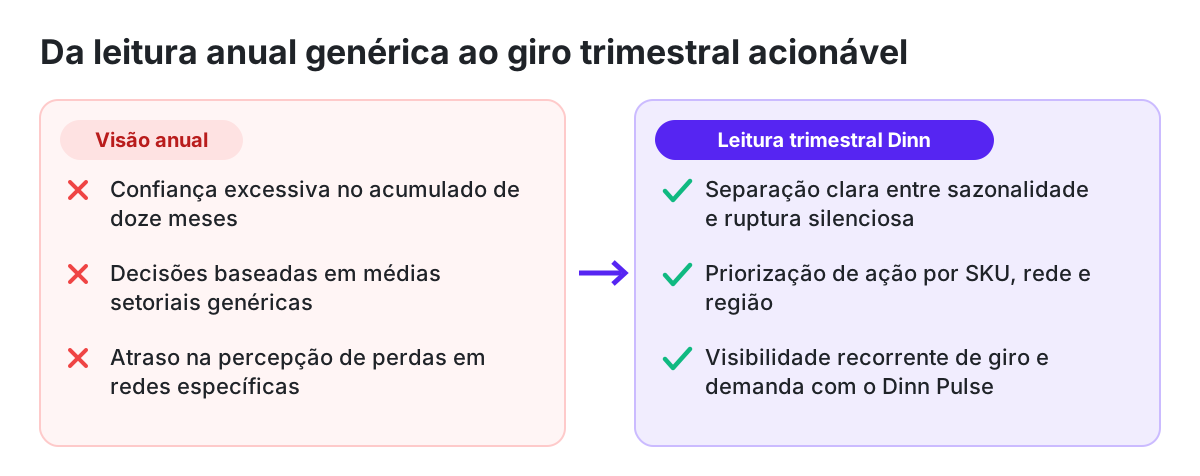
The hidden premise is that a sector average or macroeconomic indicator is useful for guiding the prioritization of stores and SKUs at the micro level. When the pace of sell-out slows down during the quarter, focusing solely on the annual accumulated data prevents the company from noticing where sales loss has already begun to take hold due to a lack of sell-out visibility in the pharmaceutical channel.
To understand the real scenario, it is necessary to separate concepts that are usually treated as equivalent: long-term accumulated growth and recent turnover behavior per point of sale, POS, and retail chain. The former shows the brand's historical momentum; the latter points out where the channel is stalling.
When quarterly deceleration sets in, the commercial team tends to react with assumptions. The brand observes growth in the annual accumulated data, but faces localized drops in strategic retail chains, running the risk of thinking that consumers have lost interest, when the real problem is the absence of product on the shelf or a silent stockout that escaped manual reports.
To overcome this lag, the operation needs recurring readings of turnover and demand. This is the case with Dinn Pulse, an expanding conditional capability that helps identify relevant movement shifts before they turn into revenue loss by crossing sales behavior with availability status.
Of course, not every deceleration is an execution failure. Short-term fluctuations may simply reflect seasonal accommodation after periods of strong expansion, with no direct relation to structural stockouts. Therefore, aggregated data never replaces fine-grained reading by SKU, region, and retail chain.
In short, the annual accumulated data serves to measure direction, but commercial decision-making requires seeing the quarter. The question left for your strategy is: in which category or retail chain does your operation feel the difference between annual consolidation and actual quarterly turnover behavior the most?
Transform data into strategic decisions
Dinn centralizes market intelligence for the pharmaceutical industry — real-time POS monitoring, out-of-stock tracking, and sell-out data.
Request a demoRecommended for you

Logistics and market share goals: what is missing in the strategy for the pharmaceutical channel?
Read article →
When a product shortage makes the news, has the damage to the pharmacy already been done?
Read article →