
How high digital demand challenges inventory visibility in the pharmaceutical channel
The growth of digital sales and demand spikes in high turnover categories expose logistical flaws that spreadsheets and static reports cannot solve.


The expansion of digital sales and the acceleration of consumption in high-value categories have changed the dynamics of pharmaceutical retail. When consumer orders surge strongly in digital channels and large chains, the distribution chain feels the impact almost immediately. The promise of convenience quickly runs up against a reality known to sales and trade teams: the product sells out in some markets while accumulating in excess in others.
There is an undeniable truth behind this pressure. Traditional reports and monthly market databases arrive far too late for those who need to manage daily replenishment. When the team discovers the absence of an item through channel reports or customer complaints, the sale has already been lost and friction with the pharmacy is established. The common mistake is to believe that the problem boils down to a one-time inventory adjustment at the distribution center or hiring yet another generic data dashboard.
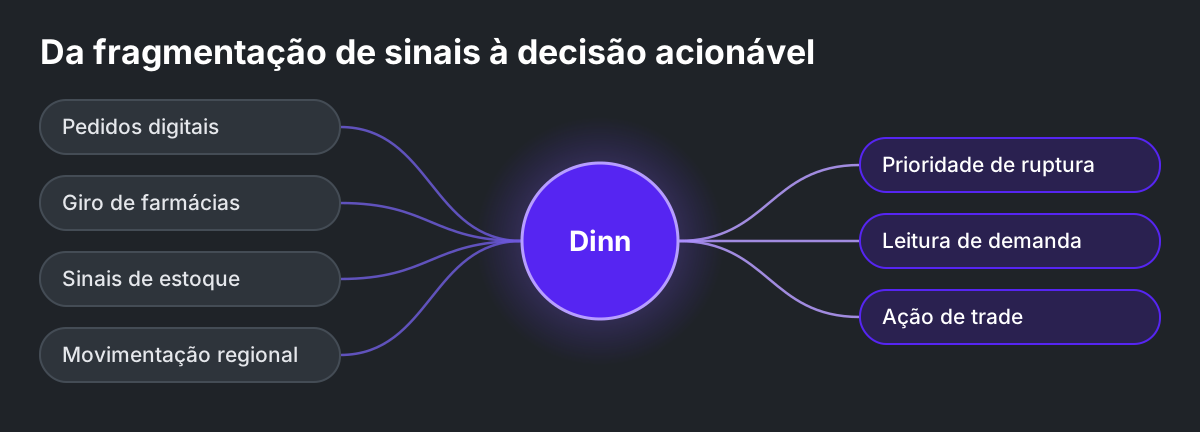
Tucked behind this view is the premise that accumulating disconnected charts and indicators is equivalent to having operational control. It is not. What teams lack is not a volume of information, but the ability to transform fragmented data into a clear priority of where to act. Without a recurring reading that distinguishes what is directly observed in chains from what must be estimated with rigorous confidence criteria, planning continues to navigate in the dark.
To overcome this lag between the consumption signal and the commercial decision, operations must separate fundamental concepts. Exact inventory captured in integrated networks has a different nature than estimated or predicted availability in pharmacies without a direct digital signal. Treating these sources as if they had the same degree of certainty leads to misguided decisions. The intelligence required for the pharmaceutical channel demands that each piece of data be accompanied by its origin, freshness, and explicit limits of interpretation.
The mechanism to shield distribution against unforeseen stockouts involves connecting channel signals and delivering them in an actionable format. Instead of forcing the analyst or representative to manually cross-reference spreadsheets, the intelligence layer organizes the commercial routine by pointing out exactly where the risk of absence is critical by SKU, chain, and region. Capabilities like Dinn Stock help prioritize field and trade efforts before stockouts turn into financial loss.
The cost of deciding late in the pharmaceutical channel is high. Managing high turnover categories requires abandoning the illusion that national averages solve the micro-vision of the point of sale. Competitive advantage belongs to brands that can see the real behavior of the channel and direct commercial action to where the product is truly missing.
Turn data into decisions
Dinn shows where pharmacies lack the product, what changed and where to act first, with source and confidence.