
Why regional stockout diagnosis fails
Regional divergences and noisy alerts prevent proper validation of pharmacy stockouts, creating false alarms and delaying commercial action.


When the sales team points out that a product is missing from the shelf, the planning team cross-references the reports and notices that the regional signal does not match the expected movement. The phrase is recurrent in planning conversations: we do not know if the product is missing in the chain or if the regional data is delayed.
The friction between data and the shelf
There is an undeniable truth in this frustration: divergences between databases create rapid operational friction. The common error is assuming that the problem is solved by gathering more spreadsheets or creating a larger dashboard. In practice, more data volume without context merely multiplies noise.
The root of the failure lies in the confusion between concepts that need to be treated separately. The exact inventory of a connected store is not the same thing as the estimated inventory of a pharmacy without a direct digital signal. Likewise, the field perception of a representative does not replace consistent evidence by SKU and point of sale.
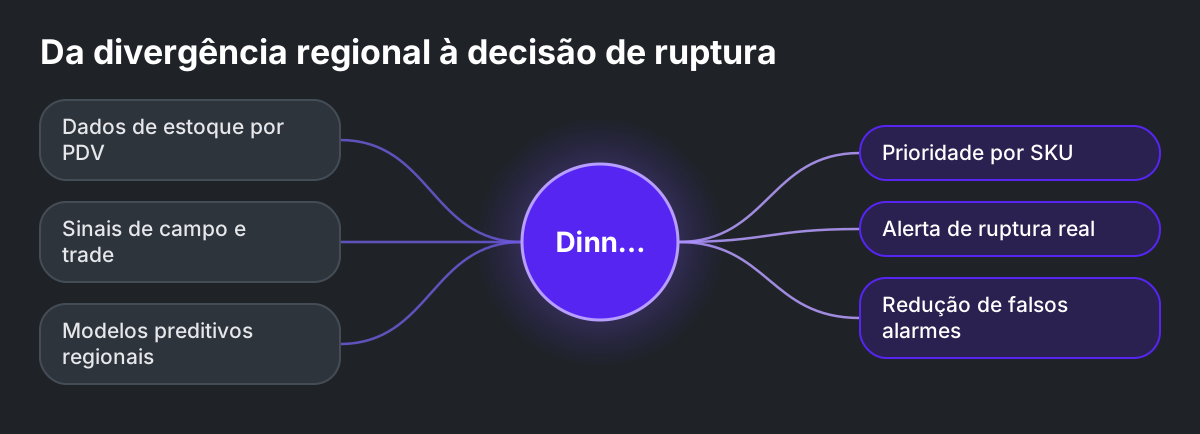
The mechanism of regional divergence
The availability signal diverges between sources without a governance layer, the diagnosis fails. The team wastes hours checking false alarms and reconciling spreadsheets, while the replenishment decision arrives too late. In sensitive categories, a failure in reading the end of the chain can mean loss of space in chains or unnecessary friction with the channel.
To overcome this cycle, the analysis needs to distinguish what is directly observed from what is inferred by predictive models. The use of intelligence applied to the pharmaceutical channel makes it possible to separate what is critical stockout from normal turnover variation, ensuring that field and trade efforts are directed to where the absence is real.
Limits and premises of availability reading
No tool eliminates the complexity of the pharmacy channel. Independent chains or regions without digital coverage require predictive models that bring premises, confidence margins, and explicit limits. Automation supports the decision, but does not replace human confirmation when critical divergence requires contact with the point of sale.
The intelligence layer of Dinn Stock acts precisely on this front, organizing the absence diagnosis and prioritizing action by SKU, chain, city, or POS.
How does your team validate today the difference between real stockout and regional data divergence?
Turn data into decisions
Dinn shows where pharmacies lack the product, what changed and where to act first, with source and confidence.