
Risk of stockouts: what the tax reform alarm reveals about the pharma supply chain
Tax reform discussions and stockout risks expose the industry's lack of prior visibility into actual point-of-sale inventory.


When major discussions about structural or tax reforms return to the center of regulatory debate, the pharmaceutical sector reacts immediately with the legitimate fear of stockouts and unsustainable pressure on logistical margins. After all, any change in the rules for the movement of goods or in operating costs directly affects the planning of those who produce and distribute in the pharmaceutical channel.
There is an undeniable truth to this concern: macroeconomic shocks and tax changes alter cost dynamics and demand complex adjustments in the supply chain. However, focusing all attention solely on the external factor conceals a prior and much more urgent operational fragility. The premise that stockouts stem exclusively from systemic and unpredictable crises usually masks the fact that the industry often lacks reliable visibility into what actually happens in pharmacies before the crisis sets in.
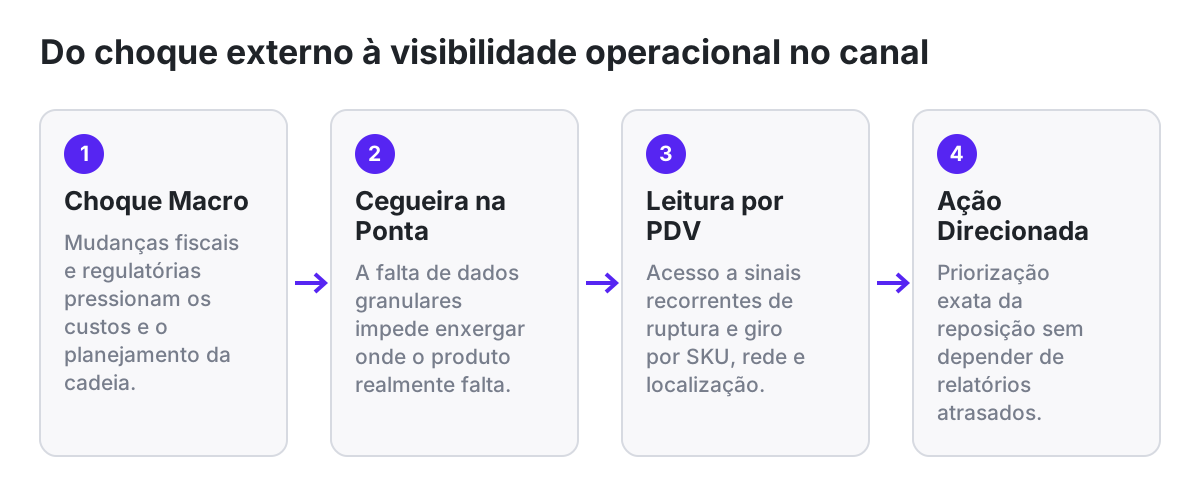
To understand the problem, it is necessary to separate two concepts that are frequently confused: the macroeconomic cost shock and operational availability visibility. The first concerns fiscal rules, input inflation, and freight conditions. The second refers to the daily ability to know where a product is missing, which chain lacks a specific SKU, and where turnover has slowed down before the customer feels the impact at the point of sale.
When a stockout alarm gains traction in the market, the practical effect is usually a delayed reaction. Without consolidated and updated data per point of sale, executive decisions end up being made based on delayed reports or generic field perceptions. The result is the uneven distribution of remaining inventory, the unnecessary increase of localized stockouts, and needless friction with the channel. The manufacturer discovers that the product has disappeared from the shelves only after sell-out has already plummeted, without being able to distinguish whether the absence came from a manufacturing failure, a distributor bottleneck, or an abrupt change in the pharmacy's purchasing behavior.
It is clear that data intelligence does not replace tax reforms nor control government decisions. The fiscal impact will continue to require financial planning and rigorous commercial negotiation. However, having a structured reading of availability drastically reduces the cost of reacting in the dark. Tools like Dinn Stock, which currently operates as the main gateway of our portfolio, help commercial, trade, and supply leaderships identify shortages, stockout risks, and replenishment priorities by SKU, chain, city, and POS based on concrete evidence.
Continuous visibility does not eliminate macroeconomic risks, but it ensures that the operation does not stumble over its own data when making critical decisions. The question that remains for your company's planning is: how does your operation separate today the stockout risk generated by external shocks from the lack of visibility at the point of sale?
Turn data into decisions
Dinn shows where pharmacies lack the product, what changed and where to act first, with source and confidence.