
Tax reform and stockout: what is actually missing in pharmacies?
Tax changes generate fears of shortages, but the true risk in pharmacies is the lack of visibility into availability per POS.


Every time the fiscal and regulatory scenario undergoes deep discussions, the pharmaceutical channel goes on high alert with the fear of widespread shortages. The concern is legitimate and reflects the apprehension that any jolt in taxation rules will paralyze the chain and leave shelves empty from north to south of the country.
It is true that tax changes directly affect margins, logistic costs, and the pace of replenishment in pharmacy chains. Adjusting prices, recalculating distribution costs, and managing central inventories under new tax rates demand intense effort from planning and finance teams of any manufacturer.
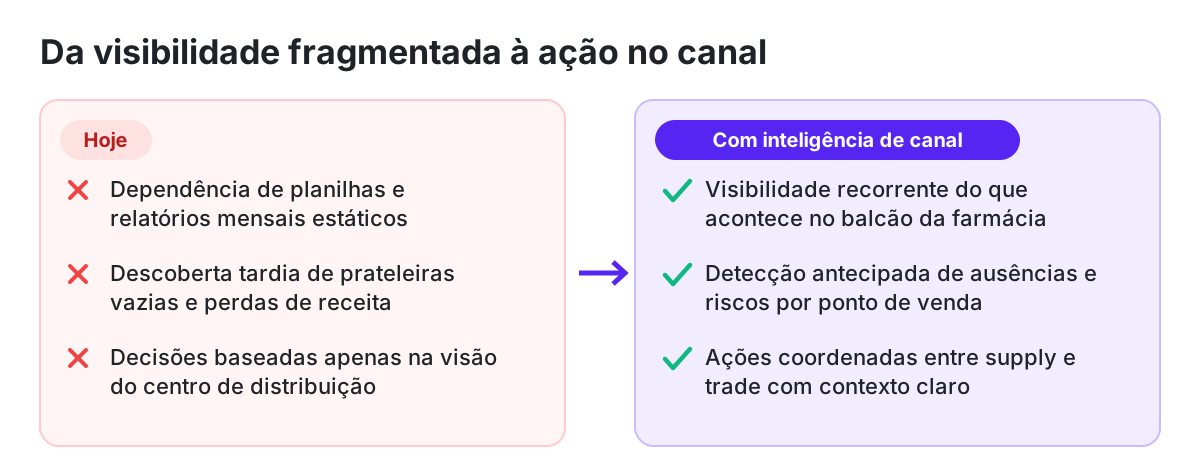
However, attributing all supply volatility solely to macroeconomic discussions hides a dangerous premise: that control over stock at the end of the chain depends exclusively on the stability of laws. In practice, many companies suffer from a lack of products in pharmacies not because of the current fiscal rule, but because they operate without recurring visibility into what actually happens at the counter.
To understand the problem, it is necessary to separate two concepts that are usually treated as equivalents: centralized logistic planning and daily execution in the channel. While the first takes care of the entry of goods into the distribution center, the second defines whether the product has reached the POS shelf or not. When regulation changes, the friction between these two worlds increases. Without continuous reading of availability by SKU, chain, and region, the manager reacts late and discovers the stockout only when the commercial impact has already occurred.
The mechanism is predictable. A rule change alters the buying behavior of intermediaries and chains, generating punctual demand fluctuations. If the industry does not see the actual movement and starts depending on static reports or monthly spreadsheets, the mismatch turns into chronic stockout. A manufacturer may believe that its stable coverage at the distribution center ensures peace of mind, while dozens of regional pharmacies accumulate shortages of essential products.
Fragmented visibility prevents fast decisions. This is why facing challenging scenarios requires intelligence integrated into the channel. The use of resources like Dinn Stock allows detecting where there is an absence or risk of stockout, prioritizing actions by chain, city, or point of sale before revenue loss sets in.
This does not mean that data intelligence replaces commercial negotiation or solves tax complexity on its own. Dinn does not control fiscal rules nor define public policies. The role of a specialized intelligence layer is to provide the missing context so that supply and trade know exactly where to act, with what confidence, and with what expected impact.
In a scenario of regulatory uncertainties, the greatest risk for the industry is not just the rule change, but continuing to decide channel distribution in the dark.
Turn data into decisions
Dinn shows where pharmacies lack the product, what changed and where to act first, with source and confidence.