
Pharmaceutical distribution under pressure: why renegotiating contracts does not solve margin loss at the POS
Discussing squeezed margins in pharmaceutical distribution without looking at the point of sale just shifts the problem. Learn why channel monitoring is the path.


Discussions about the future of pharmaceutical distribution usually return to the same point: squeezed margins, frictions in commercial negotiations, and rising logistics costs. When quarterly results shrink, the immediate reaction tends to be opening a new round of talks with distributors or seeking contractual adjustments to try to regain breathing room.
It is true that the cost to serve in the pharmaceutical channel is high and that the financial pressure on the manufacturer is real. Operating in thousands of point of sale with complex logistical requirements consumes resources and imposes severe limits on profitability. However, focusing solely on the freight rate or the commercial terms table conceals a dangerous premise: that the margin problem is strictly contractual and logistical, rather than a matter of visibility at the far end.
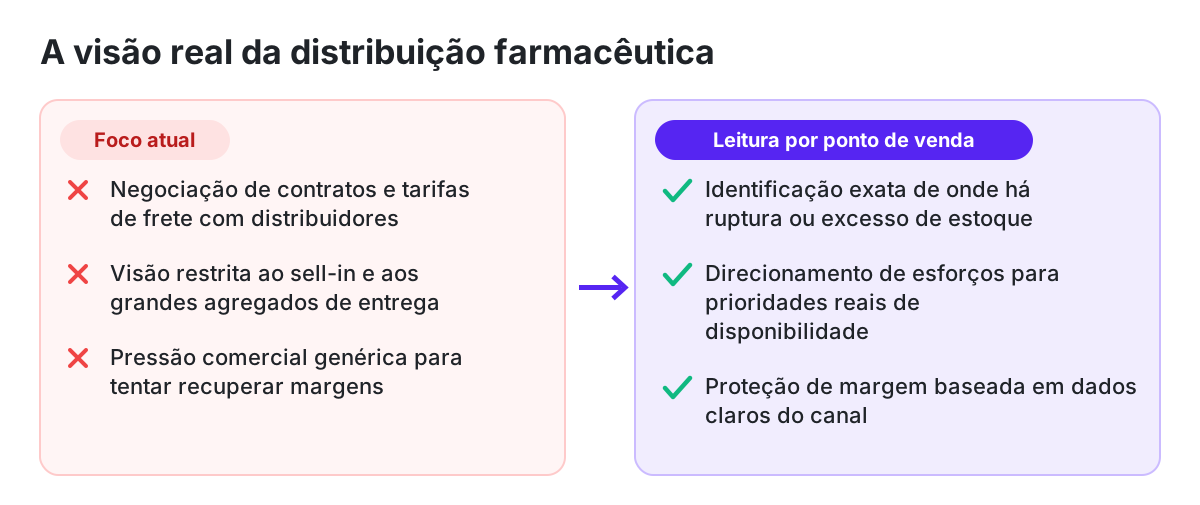
To understand where results are actually lost, it is necessary to separate two concepts that are usually treated as equivalent: the macro flow of delivery to distribution centers and the actual distribution of availability at the pharmacy counter. Controlling what enters the logistics operator does not guarantee that the product is accessible where the consumer decides to buy. Many companies continue to send standardized batches to chains that already accumulate excess in certain regions, while other stores under the same banner suffer from chronic stockout.
When analysis is limited to sell-in and large delivery aggregates, the sales team tries to compensate for margin loss with generic pressure or linear cuts. The result is unnecessary friction with channel partners and the persistence of invisible inefficiencies. Margins are not recovered simply by demanding better freight conditions; they are protected when the company manages to identify with surgical precision where the product gets stuck, where it is missing, and what the real priority of action is by SKU, chain, and city.
It is in this scenario that channel intelligence ceases to be a complementary dashboard and begins to guide daily operations. The use of Dinn Stock, for example, acts precisely in the prioritization of these fronts by pointing out where there is absence or risk of availability per point of sale, allowing the sales and trade team to direct efforts without depending on assumptions or late reports from the field.
Obviously, there are situations where the bottleneck lies in rigid transport contracts or severe working capital restrictions of certain chains, problems that require direct contractual dealings. However, negotiating without the backing of a clear reading of real availability usually results in concessions that do not solve the underlying problem.
That practical conclusion for commercial leadership is straightforward: companies that sell in pharmacies do not need yet another macro delivery report, but clarity on where to act, with what confidence, and with what expected impact. Defending margins in the channel requires viewing distribution far beyond the distribution center.
Turn data into decisions
Dinn shows where pharmacies lack the product, what changed and where to act first, with source and confidence.