
Why does the BI team always question the accuracy of stockout and distribution data?
BI's demand for data auditing in the pharmaceutical channel makes sense, but trust comes from clarity on limits and sources, not from illusions of perfection.


When a laboratory decides to structure the reading of the pharmaceutical channel, the BI team's first move is predictable and correct: requesting raw access, cross-referencing databases, and questioning the accuracy of each distribution and stockout metric before releasing any dashboard to operations. The demand for technical validation is legitimate. Data architecture must stop treating any external intelligence as a black box. However, the auditing process often stalls because it stems from a mistaken premise about how the channel works. There is a tacit expectation that for data to be useful, it must be absolute, exact, and fully cover points of sale with millimeter precision. It turns out that the pharmaceutical channel is structurally fragmented. Part of the chains has direct digital signals, while thousands of independent pharmacies require estimates, historical cross-referencing, and predictive models to fill visibility gaps. When the technical team seeks perfect data that does not exist at the root of the market, the analysis gets lost in trying to eliminate an error margin inherent to physical retail operations.
The transition between technical distrust and the effective use of information requires rigorously separating concepts that are usually treated as equivalent. It is necessary to distinguish data observed directly at the point of sale from that which was calculated, estimated, or predicted by statistical inference. Moreover, infrastructure validation and data governance must go hand in hand with the validation of business rules that support commercial decisions. A BI analyst cross-referencing the availability reading of a SKU portfolio often runs into discrepancies between digital stock and estimated stock in non-digitized chains. Without clarity on how each number was generated, the natural reaction is to block the project. The secret to unlocking this validation is not promising a flawless indicator, but openly exposing the causal trail that led to that reading.
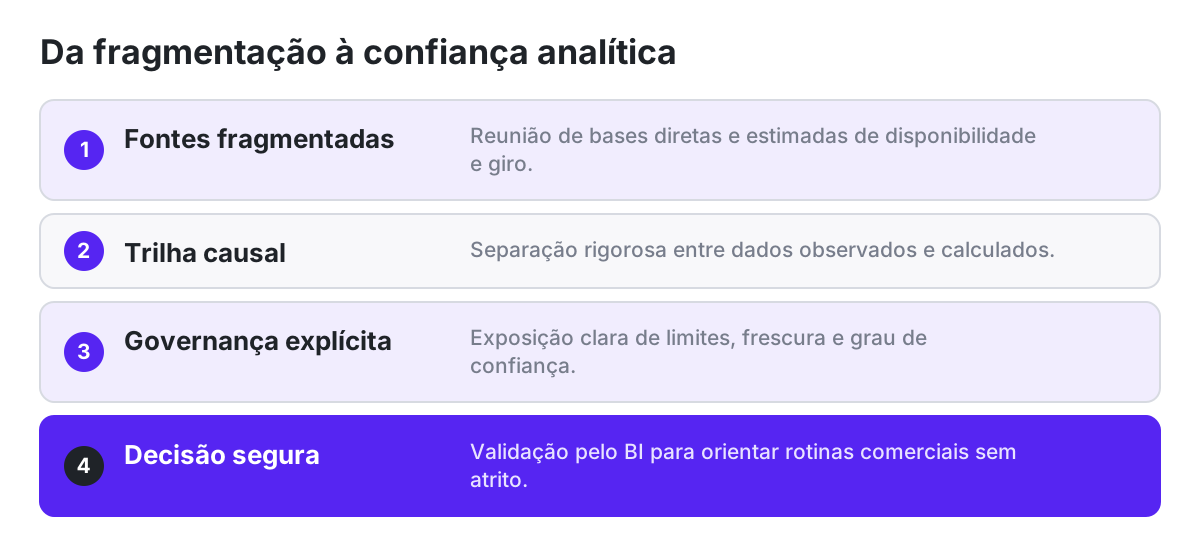
Trust in a commercial intelligence layer does not arise from a magic number that requires no checking, but from transparency regarding the origin, update date, and degree of confidence of each indicator. When the technical team can audit the origin and processing of the data, the debate changes shape. Dinn Stock acts precisely at this point, organizing fragmented sources and making explicit the freshness and limits of each availability reading to support trade and sales routines. Instead of arguing whether the database is entirely correct, the team starts evaluating whether the confidence level and explicit limits are sufficient to guide the next commercial action. Recurrent intelligence only fulfills its role when it delivers context and governance for the technical team to work without friction, transforming channel complexity into safe decisions.
Turn data into decisions
Dinn shows where pharmacies lack the product, what changed and where to act first, with source and confidence.