
What changes in the distribution strategy when new players enter the pharmaceutical channel?
The arrival of new formats in pharmaceutical retail expands capillarity, but exposes the fragility of inventory visibility in newly opened chains.


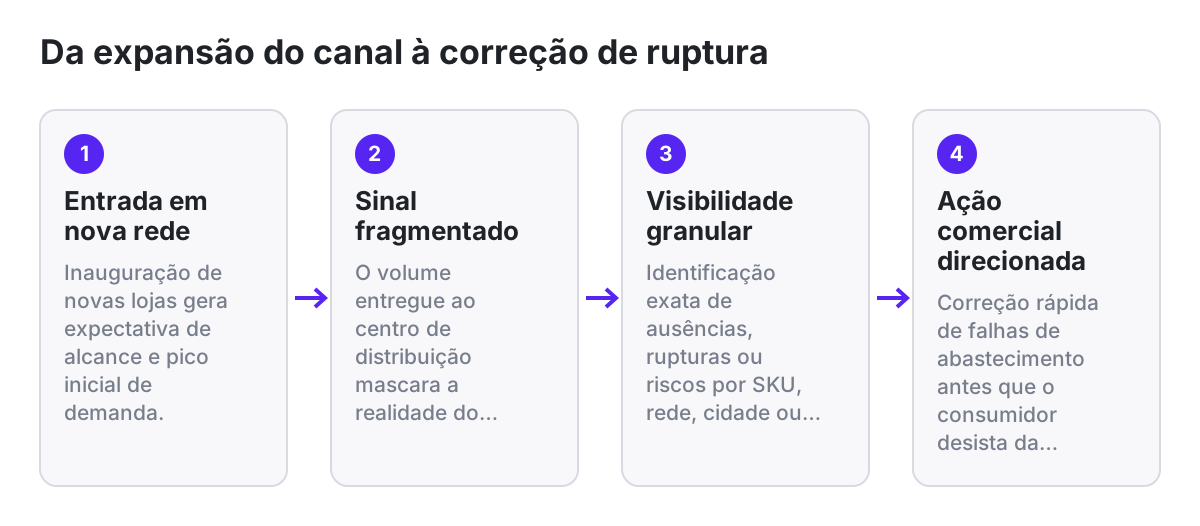
Whenever a large retail group expands its operations and opens a new pharmacy chain, the sales management faces the same dilemma: enter the assortment on day one or wait for the channel to stabilize? The movement attracts immediate attention because it promises to expand the reach of health, supplement, and consumer health brands in competitive markets.
New pharmacy formats seek to attract traffic quickly with a competitive positioning and a lean mix. It is true that this movement generates an initial demand spike that drives the shipment of goods and creates a legitimate expectation of accelerated revenue for the industry.
However, there is a hidden premise in this decision: the illusion that the contracted geographic coverage automatically guarantees the actual presence of the product on the shelf of each new store. In practice, there is a gulf between the volume delivered to the retailer's distribution center and the actual product outflow at each point of sale, POS.
The mechanism of invisible stockouts in emerging chains
When a new entrant gains space in the pharmaceutical channel, the initial replenishment flow tends to suffer from the misalignment between the buyer's projection and actual store replenishment. Without granular visibility, the sales team often discovers the absence of the product only weeks later, guided by notifications in the customer service channel or by fluctuations in replenishment.
The challenge is not the lack of merchandise in the macro, but the inability to monitor where the assortment is actually available to the consumer. Dinn Stock acts precisely on this front, identifying absences, stockouts, or availability risks and prioritizing action by SKU, chain, city, state, or point of sale, POS.
Protecting the channel with reliable data
It is argued that stockouts in new markets may just be a natural reflection of initial logistical adjustment. In fact, inventory adjustments happen. However, ignoring the behavior of these stores in the first months opens room for competitors to occupy the physical space conquered with effort.
For teams managing drug sales channels, the competitive differential is no longer just putting the product in the chain's catalog, but rather the ability to audit actual movement. Expansion only generates sustainable revenue when the sales team knows exactly where to act to correct replenishment failures before the customer gives up the search.
Turn data into decisions
Dinn shows where pharmacies lack the product, what changed and where to act first, with source and confidence.