
Why didn't the digitalization of pharmaceutical retail put an end to stockout?
Digital expansion and the use of AI in pharmacies increased data volume, but did not eliminate stockout. Learn how to structure decisions in the channel.


With the expansion of digital sales and the accelerated adoption of artificial intelligence by pharmaceutical retail, the expectation was created that the channel would operate with perfect visibility. The implicit promise is that the more connected and technological the retail chains' ecosystem is, the more transparent the journey of the product into the consumer's hands becomes.
It is true that retail has changed its pace profoundly. Today, buying behavior constantly shifts between physical pharmacies, the chains' own digital channels, and delivery platforms, generating an unprecedented volume of daily signals about market movement. However, there is a hidden premise in this evolution: that the tools adopted by the retailer to sell better automatically provide the manufacturer with the clarity it needs to operate.
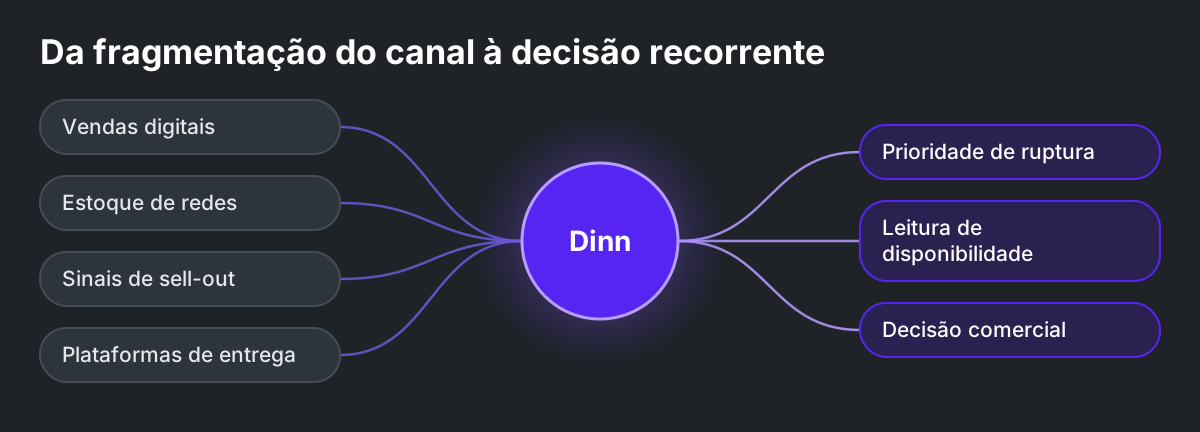
In practice, what is observed is the opposite. The more branched out medication sales channels become, the more fragmented the available data is for those who produce. The digital inventory displayed on an online platform may diverge from the physical inventory available in the same store, while independent pharmacies or regional chains operate under their own replenishment logics. For commercial leadership and the trade team, the result of this dispersion is not clarity, but rather the accumulation of disconnected dashboards that arrive too late in the decision-making routine.
The root of this misalignment lies in the confusion between the technology that retail uses to optimize its sales and the intelligence that industry needs to govern its distribution. The gross volume of information generated by digital transactions does not translate into a clear indication of where to act. When a sell-out variation is identified in a region, the time spent crossing spreadsheets, reconciling bases, and trying to understand whether the problem stems from a digital stockout, assortment failure, or demand shift tends to be longer than the cycle required to correct it.
To overcome this barrier, companies that sell in pharmacies do not need another generic control panel, but rather an intelligence layer capable of qualifying and interpreting these fragmented signals. Solutions like Dinn Stock focus on showing exactly where there is absence, stockout, or availability risk, prioritizing action by SKU, chain, city, or point of sale, POS with clear confidence criteria and explicit observation limits.
Technology applied to retail expands business opportunities, but it also increases the cost of deciding based on perception or delay. Competitive advantage in the pharmaceutical channel does not belong to those who accumulate more reports about the past, but to those who manage to transform the scattered signal into a recurring, reliable, and actionable decision.
How does your team today separate a sell-out variation generated by digital stockout from the one caused by a lack of physical inventory in the chain?
Turn data into decisions
Dinn shows where pharmacies lack the product, what changed and where to act first, with source and confidence.