
Why does consolidated chain growth mask stockouts in regional markets?
The rapid expansion of major chains requires looking beyond consolidated revenue and examining actual availability per point of sale.


The continuous expansion of the pharmaceutical retail sector and the accelerated opening of new stores create a scenario of apparent prosperity for manufacturers and brand owners. In consolidated figures, sell-in numbers show growth, and capillarity seems guaranteed. However, sales managers and trade teams face a distinct daily reality: why is revenue advancing while the brand loses space and efficiency in regional markets?
The pace of openings and logistical capillarity define market access. It is entirely true that large chains shape distribution dynamics and bring products closer to the consumer. The hidden premise, however, is assuming that aggregate revenue growth means execution and availability in each pharmacy are resolved homogeneously.
The abyss between capillarity and actual presence
At this point, it is necessary to separate two concepts that are often treated as synonyms: a chain's store opening volume and effective presence with active SKU availability per point of sale. A brand may record excellent performance in the national aggregate, driven by efficient distribution centers, but suffer severe stockouts in newly opened pharmacies or secondary markets undergoing maturation.
The mechanism is clear. Chains undergoing accelerated expansion test new markets and adjust local inventories in a decentralized manner. When the sales team relies solely on consolidated reports and analyses based exclusively on sell-in, the warning sign arrives too late. The space conquered on paper turns into dissatisfaction and lost sales at the point of sale, because the product is simply not available on the shelf when the consumer looks for it.
Adjusting the focus of commercial execution
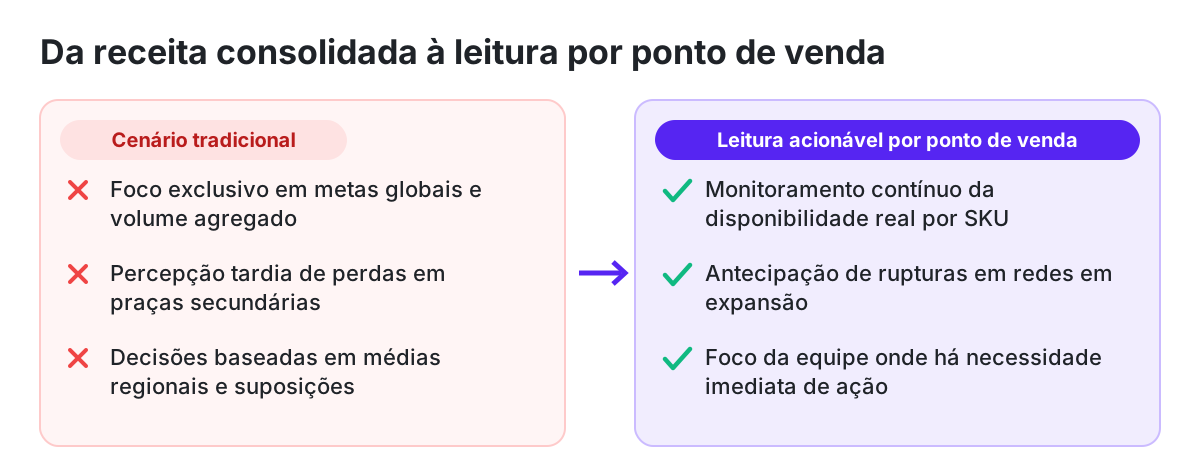
Resolving this mismatch requires changing how the company reads the channel. Instead of managing the portfolio through regional averages or generic coverage goals, the priority becomes identifying where stockouts, stockout risks, or turnover drops occur by SKU, city, and point of sale.
Intelligence tools like Dinn Stock fulfill this exact role by clearly pointing out where there is a lack or risk of availability, prioritizing action by chain and location.
Pharmaceutical commercial execution stops being guided by subjective field perceptions and begins to respond to structured signals from the channel. The central question for sales leadership is no longer how much was billed in the month, but rather where the operation needs to act right now to ensure that chain expansion translates into actual sales at the pharmacy.
Turn data into decisions
Dinn shows where pharmacies lack the product, what changed and where to act first, with source and confidence.