
Why Incomplete Vendor Data Ruins Your Demand Forecasts
Demand forecasts in the pharmaceutical channel fail when relying on raw volume without identity governance, EAN, CNPJ, and gap visibility.


When sales and inventory reports arrive with gaps, the immediate reflex tends to be the search for more databases. The prevailing premise is simple: if the model misses the forecast, the solution is to feed the system with a larger volume of information coming from different vendors and distributors.
It is true that fragmented bases and incomplete data loads coming from external partners compromise the quality of analyses. Anyone working in market intelligence leadership knows the exhaustion of spending days reconciling spreadsheets, crossing sell-in with partial reports, and trying to understand why the end number does not match what was planned at the factory.
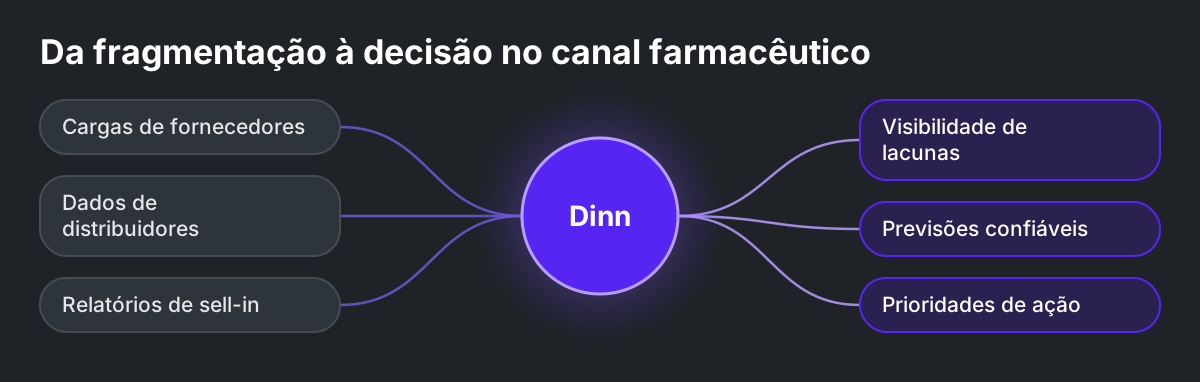
The mistake, however, lies in believing that accumulating more raw data solves the structural problem. Without a rigorous layer of identity and context, adding more files to the same spreadsheet only amplifies analytical noise.
The distortion mechanism is straightforward. When a vendor data load arrives with flaws in EAN, CNPJ, or geographic coverage, forecasting models tend to mask the absence of data as the absence of a sale. The system interprets that the product has no turnover in the region, when in reality what occurred was a failure in information transmission or a hidden stockout in the distribution chain. o get out of this cycle, it is necessary to separate raw collected data from data treated with governance. Intelligence focused on the pharmaceutical channel needs to show the origin and daily update of each record, clearly distinguishing what was observed from what was estimated.
It is precisely on this front that Dinn Stock acts as an available gateway to identify absences and prioritize where to act by SKU and chain.
Naturally, not every distortion comes from vendor failures. Rapid changes in consumer behavior or seasonal variations also influence the result, and no technology replaces human validation of regional coverage. External sources with structural delay should never be treated as immediate readings.
Reliable forecasts in the pharmaceutical channel require identity governance and gap visibility, not just more data volume. How does your team currently handle discrepancies between what the vendor delivers and what the pharmacy actually commercializes?
Turn data into decisions
Dinn shows where pharmacies lack the product, what changed and where to act first, with source and confidence.