
Why pharmaceutical sales channel expansion fails before the shelf
Opening new drug sales channels generates a sell-in peak, but silent stockout at the endpoint masks the true product turnover.


When established brands expand their presence and new retail formats enter the sector, the promise of immediate capillarity dominates commercial planning. The move is natural: after all, accessing new banners and regional chains seems like the most direct path to capture demand in previously unexplored markets.
What rarely receives due attention is the speed with which this initial supply translates into real availability at the endpoint. The common assumption that the volume shipped to a new chain's distribution center guarantees presence on the shelf tends to mask critical operational failures in the first weeks of operation.
The abyss between the warehouse and the shelf
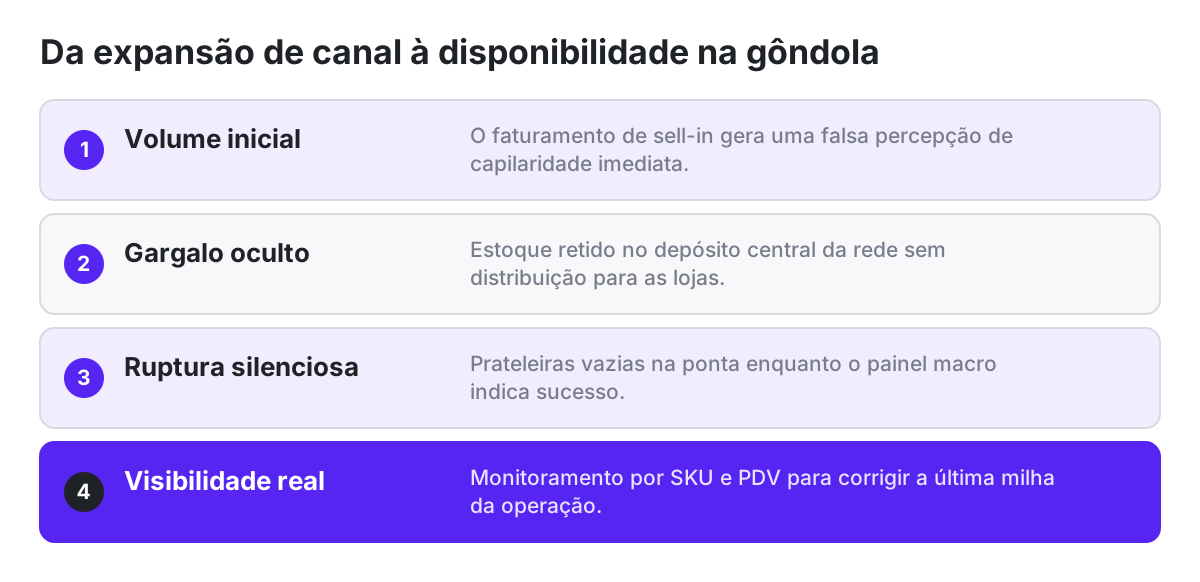
The most frequent analytical error lies in treating sell-in and initial sell-out as equivalent metrics of market acceptance. When a chain that is new to the pharmaceutical channel receives the first batches of a portfolio, the central indicators record an expressive jump in revenue and numerical distribution. However, the inventory centralized in the chain's warehouses does not mean that the medication is accessible to the consumer at the neighborhood pharmacy.
Without granular visibility per point of sale, commercial leadership interprets the initial volume as a demand success, while the field reports empty shelves due to a lack of internal capillarity in the chain's own distribution. The result is a vicious cycle: the product gets stuck in the central warehouse of some regions while completely missing in other high-traffic ones.
The anatomy of silent stockout
The mechanism that causes this distortion involves the fragmentation of operational data. Expanding chains or formats recently arrived in pharmaceutical retail face logistical bottlenecks in redistribution to physical stores. If the industry only monitors the macro revenue panel, the absence of sales in the following weeks is precipitously treated as consumer rejection or price weakness.
In practice, what occurred was an execution failure in the last mile of the channel. Without data that separates visible inventory from hidden inventory, the team wastes precious time trying to fix marketing campaigns when the real problem is physical availability.
How to guide expansion with confidence
To prevent entry into new drug sales channels from becoming an exercise in trial and error, monitoring needs to go beyond the issued invoice. It is necessary to track real presence by SKU, chain, and city, distinguishing what was billed from what actually rests on the shelf.
This is where the intelligence layer of Dinn Stock acts, mapping stockouts and prioritizing actions per point of sale. Knowing where the product is truly missing transforms expansion from a blind bet into a controlled and predictable operation.
Turn data into decisions
Dinn shows where pharmacies lack the product, what changed and where to act first, with source and confidence.