
Why the stockout risk in the pharmaceutical channel begins long before the factory
Stockouts in pharmacies are rarely just an isolated production problem. Learn how to anticipate the risk and protect inventory per POS.


The supply problem only appears, in practice, when the pharmacy is already out of the product on the shelf. It is at that moment that sales and supply chain leadership must deal with late warnings, channel complaints, and the perception that the chain has lost control of the point of sale.
Structural and fiscal changes amplify the vulnerability of the channel, forcing the industry to react to stockouts too late. It is true that regulatory shocks, tax adjustments, and macroeconomic fluctuations alter margins, affect delivery dynamics, and generate real friction at the end of the chain. However, attributing every availability failure to external factors hides a deeper operational fragility.
The premise of global volume
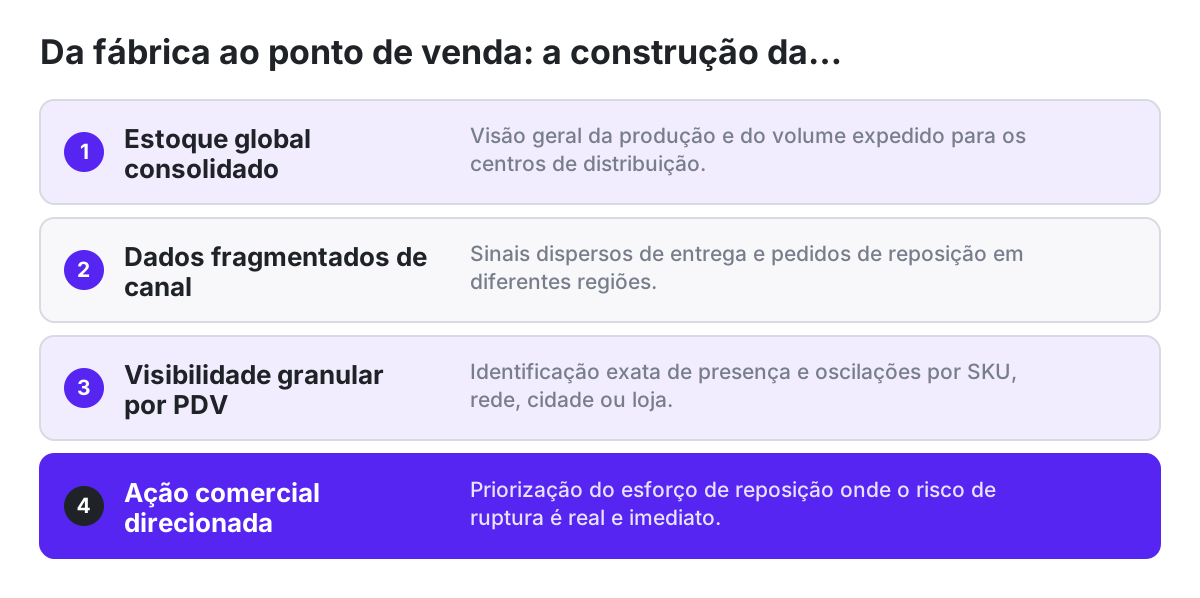
The hidden premise behind many supply crises is that the global volume manufactured automatically guarantees presence at the point of sale. When the company's central indicator is solely sell-in or the volume shipped to large distribution centers, the invisibility of what happens on regional shelves starts to be treated as a mere detail.
In reality, there is a chasm between global inventory and actual availability per POS. A product line may look healthy in consolidated factory reports, but suffer severe distribution fluctuations across dozens of regional chains. Without granular visibility, the sales team only discovers the problem when replenishment orders simply stop arriving.
The cost of deciding with delay
The fragmentation between what leaves the central warehouse and what the consumer finds in the pharmacy creates recurring blind spots. Inventory disappears in specific banner pharmacies or distant regions without planning noticing the movement in time to act. When a stockout sets in, the replenishment cost is high, generates commercial friction, and opens space for unwanted substitutions by the competitor.
An ordinary mistake is trying to resolve this mismatch with generic safety stocks or meetings based on subjective field perceptions. Safety stock protects against macro uncertainty, but does not fix geographic blindness. Without data that differentiates what is available from what is absent by SKU, chain, city, or point of sale, any contingency plan arrives too late.
Anticipating stockouts with channel intelligence
Protecting the portfolio requires changing the nature of the decision. Instead of reacting to product shortages with manual spreadsheets and delayed reports, the commercial operation needs recurring visibility into where the risk of stockout is real.
It is precisely to solve this gap that Dinn Stock acts as an intelligence layer, showing where there is a stockout, absence, or imminent availability risk, and prioritizing action by SKU, chain, city, state, or POS. The priority stops being guessing where the product is missing and starts being directing replenishment effort where the impact is immediate.
Anticipating stockout risk does not mean predicting the unpredictable, but eliminating blind spots between the factory and the shelf before the channel feels the impact.
Turn data into decisions
Dinn shows where pharmacies lack the product, what changed and where to act first, with source and confidence.