
Why the debate on stockouts in the pharmaceutical channel ignores the pharmacy counter
Macroeconomic discussions on the pharmaceutical chain ignore that stockout is a daily issue of visibility and execution.


Discussions on structural and regulatory impacts in the drug supply chain tend to occupy executive meetings and sectoral debates as a purely macroeconomic topic. The recurring argument revolves around logistic costs, pressured margins, and the pace of price adjustments. However, when commercial and trade marketing leadership turns its attention to the actual operation, the symptom that appears at the end of the line is different. The biggest problem of an operation in the pharmaceutical channel is not the general rule on paper, but figuring out where the product will run out before the pharmacy places the order or the patient goes without service.
It is true that regulatory and tax changes directly affect distribution dynamics, altering the flow of goods among laboratories, distributors, and chains. But there is a hidden premise behind much of traditional analysis: the idea that logistic and fiscal bottlenecks can be bypassed just through alignment meetings and consolidated sell-in projections, without the need to observe the actual inventory behavior per point of sale.
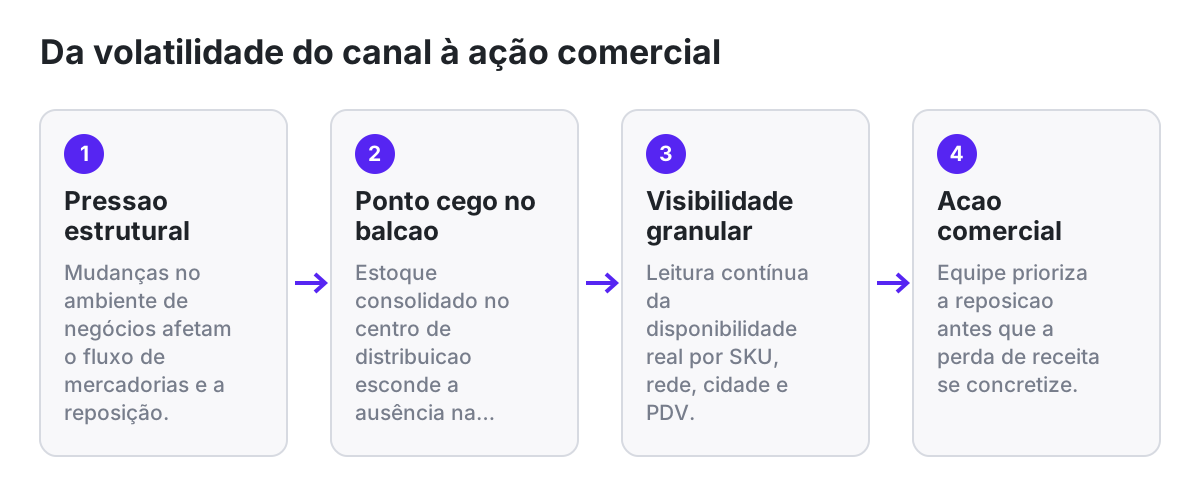
When the chain suffers any type of systemic pressure, intermediate links adjust their purchasing pace and replenishment loses predictability. It is at this moment that visibility blind spots multiply. The common mistake is to treat sell-in and sell-out as operational synonyms. A consolidated inventory at the distribution center or a billed order for a large chain does not guarantee that the product is on the shelf, accessible to the consumer at the time of purchase. Without granular visibility, the commercial team discovers the disappearance of a critical SKU only when sales volume drops to zero and the customer service channel begins to record complaints.
To anticipate stockouts and protect the portfolio, leadership needs to go beyond general market perception and consolidated delivery reports. The mechanism requires continuous monitoring of actual availability per SKU, chain, city, state, and point of sale, POS. This is where Dinn Stock comes in, a structured capability to show exactly where there is absence, risk of stockout, or replenishment opportunity in the channel, prioritizing the action of the field or trade team before revenue loss materializes.
Obviously, data visibility does not eliminate extreme logistic shocks or deep systemic manufacturing constraints. Furthermore, pharmacies without direct digital signals require predictive models with explicit confidence margins and clear limits of interpretation. The central point, however, is that managing distribution based solely on the past or on regional averages ceases to be efficient when volatility increases.
Visibility must precede questioning. How does your team monitor the risk of product absence before the channel reports the loss of sale?
Turn data into decisions
Dinn shows where pharmacies lack the product, what changed and where to act first, with source and confidence.