
Why the risk of out-of-stock in the pharmacy only shows up when the sale is already lost
Learn why stockout in the pharmaceutical channel is often noticed too late and how to anticipate product absence before the customer migrates to a competitor.


The alert that arrives too late
There is a common routine among sales teams operating in the pharmaceutical channel: realizing that a product has disappeared from the shelf usually only happens when the consolidated report points to a drop in revenue or when the customer has already migrated to a competing alternative. The market's perception of episodes involving a lack of supplies and medications frequently runs into the same operational limitation. The signal that the operation is failing arrives when the damage has already been done.
This delay does not stem from inattention by trade and sales teams, but from the very structure of the available data. When monitoring relies on periodic consolidations and fragmented field reports, the line separating normal demand fluctuation from the real risk of stockout becomes invisible. The result is a late reaction to a problem that had been developing for weeks.
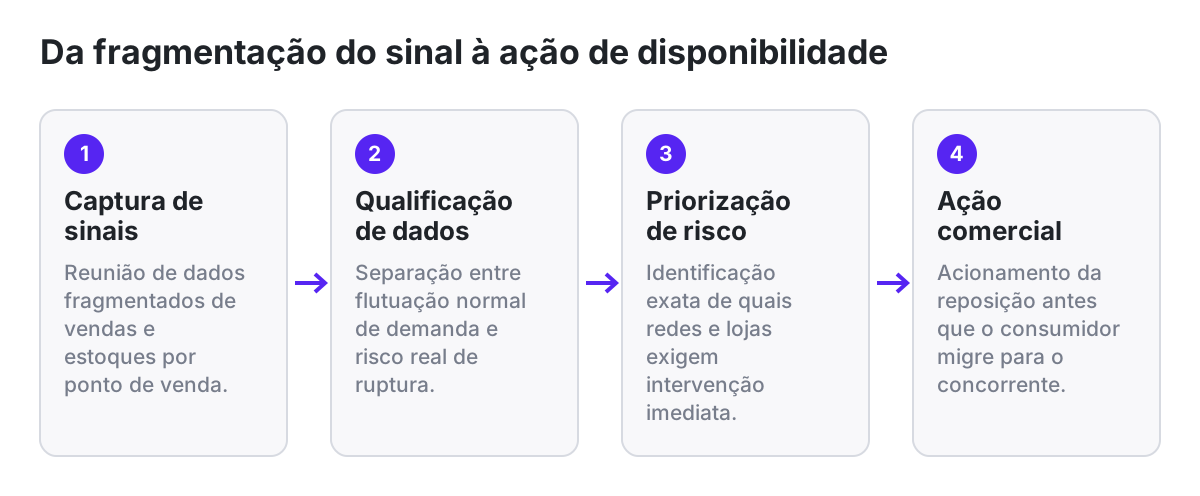
The illusion of centralized inventory
Mismanaging availability often starts by treating the distribution center and the point of sale as equivalent realities. Having the product manufactured, released, and stored in central logistics generates a false sense of security. For the patient or consumer looking for the medication at the neighborhood pharmacy, presence in the central inventory is irrelevant if the physical shelf is empty.
Stockouts rarely happen homogeneously across the entire national territory. They manifest themselves in a fragmented manner, affecting specific chains, determined cities, or microregions before compromising the company's overall indicator. When sales leadership notices the movement through national aggregates, the problem has already taken root in hundreds of points of sale.
How to separate demand fluctuation from structural risk
To anticipate stockouts, the organization needs to abandon reactive reading and start monitoring absence by SKU, chain, city, and POS with consistency. This requires crossing fragmented data sources to answer a simple question: is the product not selling because consumer interest dropped, or because it is physically not there to be bought?
When the analysis separates the drop in sell-out motivated by a loss of preference from that generated by a replenishment failure, the team's focus shifts. Instead of wasting time reconciling manual spreadsheets and justifying variances after the month closes, the sales committee begins to see exactly which stores present an imminent risk of absence.
The role of availability intelligence
Facing the complexity of the pharmaceutical channel requires an intelligence layer capable of connecting the dispersed points of the chain. It is precisely to solve this visibility gap that Dinn Stock acts as a gateway, showing where there is a stockout, absence, or availability risk and prioritizing action by SKU, chain, city, state, or POS.
When the sales team has a prioritized list of where to act, the operation stops putting out fires based on the subjective perception of the field. The decision to trigger replenishment, negotiate with the chain, or adjust distribution ceases to be a guess and becomes a structured response to a signal captured in time.
How does your team monitor the risk of stockout before the shelf goes empty?
Turn data into decisions
Dinn shows where pharmacies lack the product, what changed and where to act first, with source and confidence.